Biomarkers & Precision Medicine
Understanding ctDNA and Liquid Biopsy
Medically reviewed by Dr. Julio Cantillo, NMD How we review
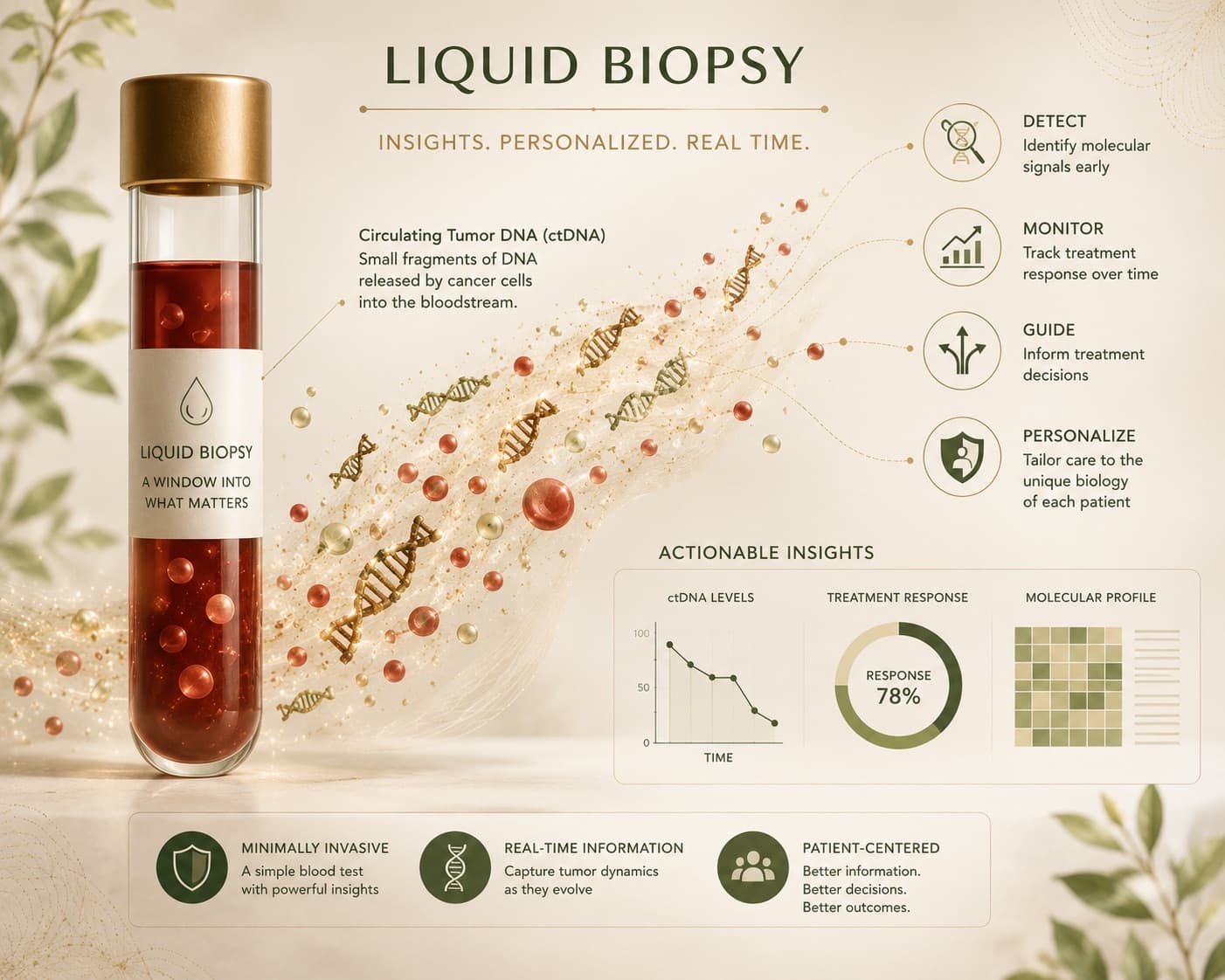
What is ctDNA?
Circulating tumor DNA, or ctDNA, refers to small fragments of DNA shed by cancer cells into the bloodstream. A liquid biopsy is a blood-based test that can sometimes detect tumor-related genetic changes without needing a tissue biopsy (Moding et al., Cancer Discovery, 2021).
How it may be used
Depending on the test and cancer context, ctDNA may be used to identify targetable mutations, monitor response, detect resistance mechanisms, or evaluate minimal residual disease. The clinical utility varies by cancer type and setting.
What a result can and cannot tell you
A positive result may provide useful information, but a negative result does not always mean cancer is absent. Tumor shedding, assay sensitivity, disease burden, timing, and biology can all affect results (Chen et al., Molecular Diagnosis & Therapy, 2021).
How integrative care uses this information
Integrative oncology should not overinterpret ctDNA. It can help patients understand results, prepare questions for oncology, and align lifestyle and supportive care with the larger treatment plan.
Practical takeaways
- ctDNA is a blood test that can detect tumour DNA; its role is still being defined for many cancers.
- A negative result does not guarantee absence of disease, and a positive result needs clinical context.
- How ctDNA is used should be your oncology team's decision, not an add-on ordered elsewhere.
- Do not let a ctDNA result drive supplement or lifestyle decisions on its own.
How SANAVITA Health approaches this
SANAVITA Health provides physician-led integrative oncology education and support with a focus on clarity, safety, whole-person care, and collaboration. The goal is to help patients understand their options, reduce avoidable risk, and build a supportive plan that fits their diagnosis, treatment phase, values, and care team recommendations.
Research references
- Moding EJ, et al. Circulating tumor DNA minimal residual disease in solid tumors. Cancer Discovery. 2021 https://pmc.ncbi.nlm.nih.gov/articles/PMC8976700/
- Honoré N, et al. Liquid Biopsy to Detect Minimal Residual Disease. Frontiers in Oncology. 2021 https://pmc.ncbi.nlm.nih.gov/articles/PMC8582541/
- Chen K, et al. Commercial ctDNA assays for minimal residual disease detection of solid tumors. Molecular Diagnosis & Therapy. 2021 https://pmc.ncbi.nlm.nih.gov/articles/PMC9016631/
- National Cancer Institute. Complementary and Alternative Medicine for Patients https://www.cancer.gov/about-cancer/treatment/cam/patient