Sleep & Routines
Sleep Architecture in Children and Its Role in Development
Medically reviewed by Dr. Thiago Cavalcante, NMD How we review
The short answer
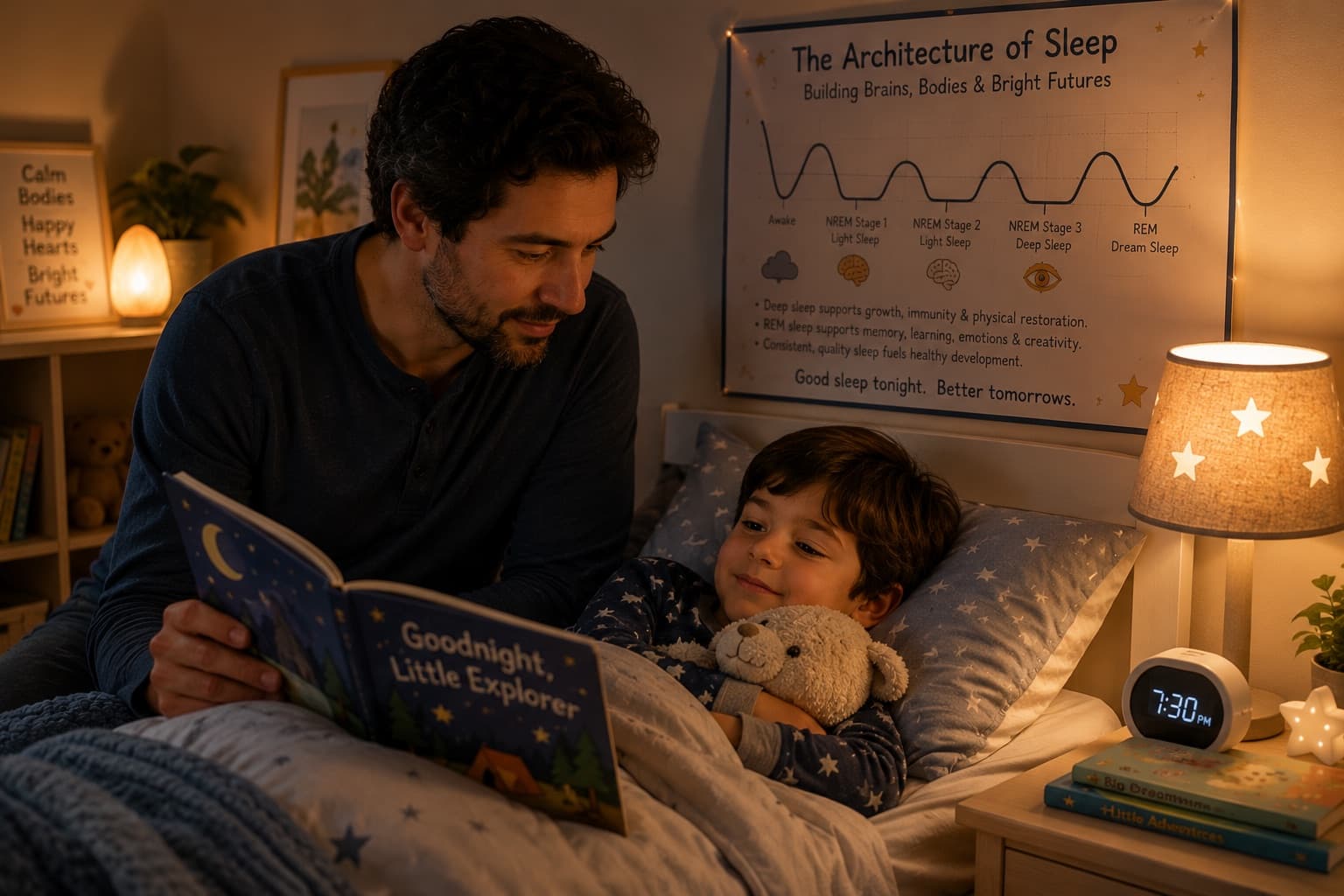
Sleep isn’t one uniform state. Through the night, children cycle between lighter sleep, deep slow-wave sleep and REM (dreaming) sleep, and the balance between them shifts dramatically from infancy to adolescence. Each stage contributes to development; deep sleep and REM sleep in particular support learning, memory and growth. Protecting enough sleep, at regular times, is the most practical way to protect its structure.
The stages of sleep
- Non-REM sleep has three stages, from light (N1 and N2) to deep slow-wave sleep (N3). In deep sleep, the brain’s electrical activity slows and a child is hardest to wake.
- REM sleep is when most vivid dreaming happens: the brain is active while most muscles are relaxed.
A full cycle lasts roughly 50 to 60 minutes in infants and about 90 minutes by adolescence. Deep sleep is concentrated in the first part of the night and REM sleep in the second.
How sleep changes with age
Newborns spend about half of their sleep in active, REM-like sleep — far more than adults. Through childhood, deep slow-wave sleep is plentiful; it declines through adolescence as sleep timing also shifts later. These changes track brain development: periods of rapid growth and reorganization of the brain coincide with high amounts of deep and REM sleep (Mason et al., 2021).
What sleep does for development
- Learning and memory. In children, sleep after learning helps consolidate new skills and information (Mason et al., 2021).
- Growth. Much of the body’s growth hormone is released during deep sleep.
- Emotion and behavior. Short sleep makes children more irritable, impulsive and inattentive — symptoms that can look like ADHD.
- Health. Regularly sleeping less than recommended is associated with attention, behavior and learning problems, injuries, high blood pressure, obesity, diabetes and depression (Paruthi et al., 2016).
How much sleep is enough
The American Academy of Sleep Medicine recommends, per 24 hours (Paruthi et al., 2016):
- Infants 4–12 months: 12–16 hours, including naps
- Children 1–2 years: 11–14 hours, including naps
- Children 3–5 years: 10–13 hours, including naps
- Children 6–12 years: 9–12 hours
- Teenagers 13–18 years: 8–10 hours
Common things that disrupt sleep
- Irregular schedules and late bedtimes (see our article on circadian rhythm)
- Screens in the bedroom (Hale & Guan, 2015)
- Snoring and sleep apnea, often from enlarged tonsils and adenoids
- Anxiety, pain, reflux, itchy eczema or asthma at night
- Caffeine from sodas, teas and energy drinks
Night terrors, sleepwalking and nightmares
Night terrors and sleepwalking come out of deep sleep, usually in the first few hours of the night. The child is hard to wake and won’t remember it in the morning. Both are common in young children and usually outgrown. Keep the child safe, don’t try to wake them forcefully, and make sure they are getting enough sleep, since overtiredness makes these episodes more likely. Nightmares, by contrast, come from REM sleep later in the night; children wake up from them and remember them.
When to call your pediatrician
The American Academy of Pediatrics recommends asking about snoring at routine visits (Marcus et al., 2012). Call your pediatrician about:
- Snoring most nights, especially with gasping or pauses in breathing
- Restless sleep together with daytime sleepiness, hyperactivity or learning problems
- Night-time episodes that are frequent, dangerous, or happen in the second half of the night
- Ongoing insomnia, or a child who can’t stay awake during the day
How a naturopathic visit can help
We look at sleep as part of the whole day — schedule, light, activity, meals, screens and stress — and screen for medical causes that break sleep up, including snoring, allergies and reflux. Dr. Cavalcante’s specialty background in otorhinolaryngology (ear, nose and throat medicine) informs how we assess snoring and airway concerns, and we refer for a sleep study or to an ENT surgeon when the history suggests sleep apnea. Routines come first; melatonin and other supplements have a narrower role than many families expect.
Practical takeaways
- Children cycle through light, deep and REM sleep, and each stage supports development.
- Deep sleep is concentrated early in the night, so an early, regular bedtime protects it.
- Short or broken sleep can look like a behavior or attention problem.
- Regular snoring is worth raising with your pediatrician.
Research references
- Mason GM, et al. Sleep and human cognitive development. Sleep Med Rev. 2021;57:101472 https://doi.org/10.1016/j.smrv.2021.101472
- Paruthi S, et al. Recommended Amount of Sleep for Pediatric Populations: A Consensus Statement of the American Academy of Sleep Medicine. J Clin Sleep Med. 2016;12(6):785-786 https://doi.org/10.5664/jcsm.5866
- Marcus CL, et al. Diagnosis and management of childhood obstructive sleep apnea syndrome. Pediatrics. 2012;130(3):576-584 https://doi.org/10.1542/peds.2012-1671
- Hale L, Guan S. Screen time and sleep among school-aged children and adolescents: a systematic literature review. Sleep Med Rev. 2015;21:50-58 https://doi.org/10.1016/j.smrv.2014.07.007