Sleep & Routines
Circadian Rhythm in Children: Why It Matters More Than You Think
Medically reviewed by Dr. Thiago Cavalcante, NMD How we review
The short answer
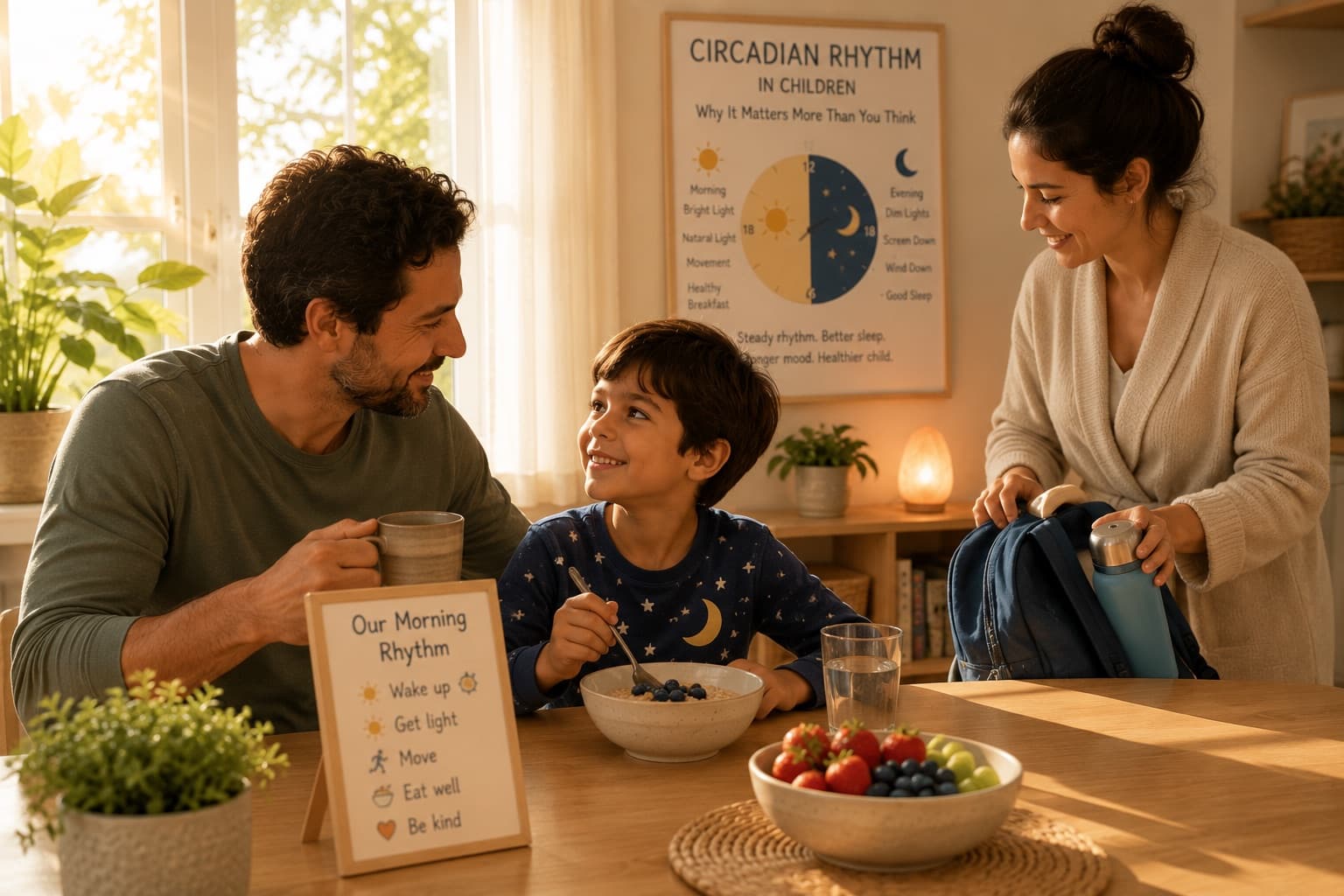
Every child has an internal clock that times sleep, alertness, hunger and hormones across the day. Light is its strongest signal: bright light in the morning sets it, and bright or screen light in the evening pushes it later. A steady wake-up time, morning daylight and a dim, screen-free hour before bed are the most effective ways to keep it on track.
What the internal clock does
Circadian rhythms are cycles of roughly 24 hours run by a master clock in the brain, which light entering the eyes keeps in step with the day. As evening falls, the body releases melatonin, a signal that night has begun; morning light switches it off. The same clock shapes when a child feels hungry, when body temperature dips and when attention is sharpest. When bedtime is out of step with the clock, children tend to take longer to fall asleep and sleep less, even if the hours in bed look adequate.
How much sleep children need
The American Academy of Sleep Medicine recommends 9 to 12 hours a night for children aged 6 to 12 and 8 to 10 hours for teenagers; younger children need more, including naps (Paruthi et al., 2016). Our article on sleep architecture lists the hours for every age. Timing matters as much as quantity: the same number of hours, taken at a consistent time, is more restorative than sleep that shifts from night to night.
The teenage shift is real
Around puberty the clock shifts later, so teenagers genuinely find it hard to fall asleep early. Combined with early school start times, that leaves many teens chronically short of sleep. The AAP has urged middle and high schools to start at 8:30 a.m. or later for this reason (Adolescent Sleep Working Group, 2014). At home, the same principles help: consistent wake times, morning light, and protecting the last hour before bed.
Screens and evening light
In a review of 67 studies, screen use was linked to shorter or later sleep in 90% of them (Hale & Guan, 2015). Light from screens, the stimulation of the content and the time it displaces all play a part. Keeping devices out of the bedroom and switching them off an hour before bed is one of the simplest, most effective changes a family can make.
Practical ways to set the clock
- Keep wake-up time consistent, including weekends — within about an hour.
- Get outdoors, or at least near a bright window, soon after waking.
- Keep meals at regular times; breakfast helps anchor the morning.
- Dim the lights and turn off screens an hour before bed.
- Keep the bedroom dark, cool and quiet; a dim night-light is fine if needed.
- Time naps to suit your child’s age, and avoid late-afternoon naps in children who struggle to fall asleep.
When to call your pediatrician
- Loud snoring most nights, pauses in breathing, or gasping during sleep (Marcus et al., 2012)
- Persistent difficulty falling or staying asleep despite a steady routine
- Daytime sleepiness, falling asleep in class, or big changes in mood or behavior
- A teenager who can’t fall asleep until very late even with good habits, especially if school is suffering
How a naturopathic visit can help
We map the child’s actual day: wake time, light exposure, meals, activity, screens, homework load and the bedtime routine. Small changes in timing often matter more than supplements. We also look for contributors such as anxiety, nasal congestion or restless legs, and we coordinate with your pediatrician or a sleep specialist when snoring or breathing pauses suggest sleep apnea. Melatonin has a place in some situations — see our article on melatonin and children — but it works best when the clock’s basic signals are already in place.
Practical takeaways
- Light is the clock’s strongest signal: bright mornings, dim evenings.
- A consistent wake-up time matters more than a perfect bedtime.
- Screens out of the bedroom, and off an hour before bed.
- A teenager’s later clock is biological; protect their sleep where you can.
- Snoring with pauses in breathing needs a medical evaluation.
Research references
- Paruthi S, et al. Recommended Amount of Sleep for Pediatric Populations: A Consensus Statement of the American Academy of Sleep Medicine. J Clin Sleep Med. 2016;12(6):785-786 https://doi.org/10.5664/jcsm.5866
- Adolescent Sleep Working Group; Committee on Adolescence; Council on School Health. School start times for adolescents. Pediatrics. 2014;134(3):642-649 https://doi.org/10.1542/peds.2014-1697
- Hale L, Guan S. Screen time and sleep among school-aged children and adolescents: a systematic literature review. Sleep Med Rev. 2015;21:50-58 https://doi.org/10.1016/j.smrv.2014.07.007
- Marcus CL, et al. Diagnosis and management of childhood obstructive sleep apnea syndrome. Pediatrics. 2012;130(3):576-584 https://doi.org/10.1542/peds.2012-1671